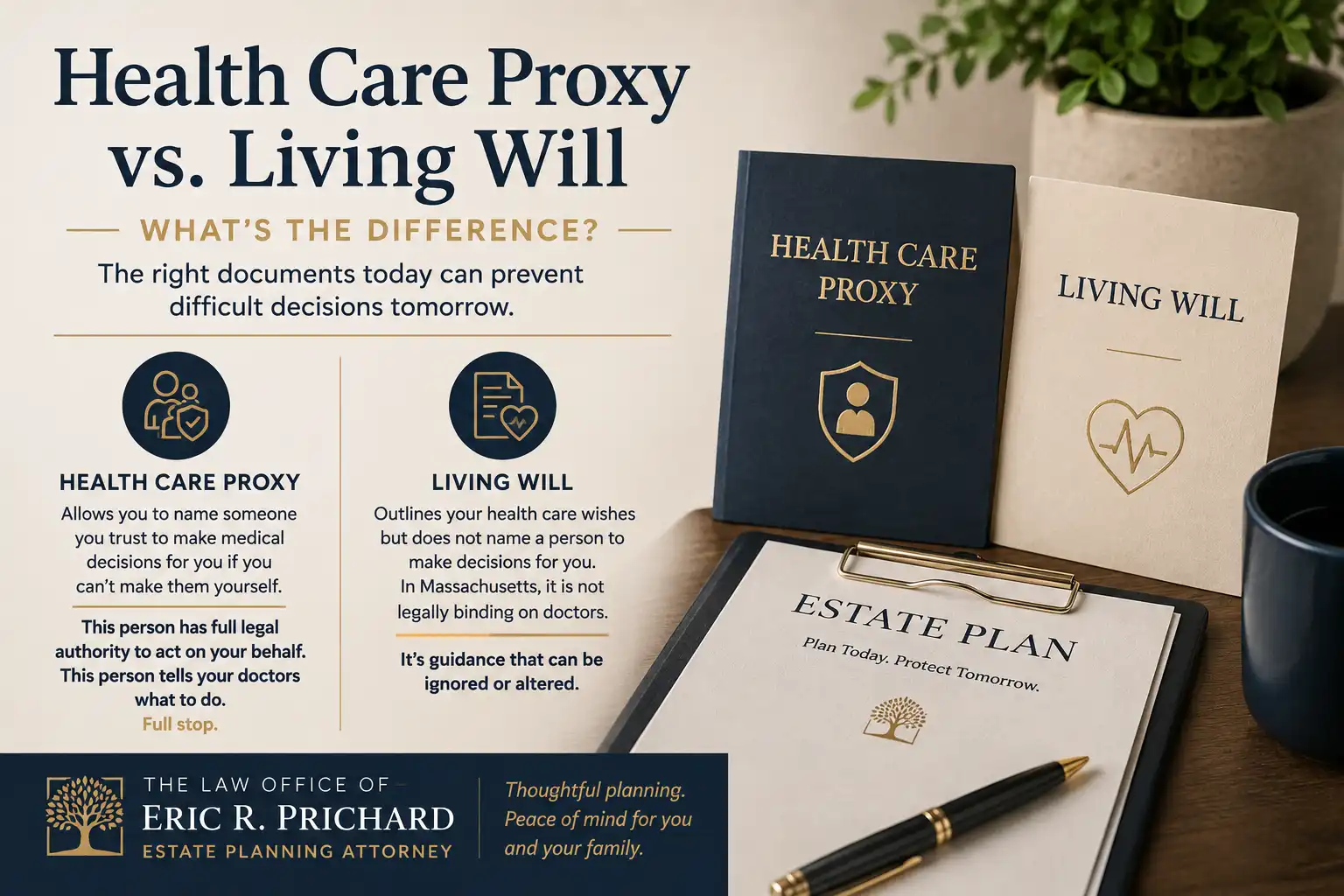
When the time comes for someone to help you with your healthcare decision making, it’s crucial for you to have the right estate plan in place since minor differences in your documents can cause major problems for your family. Understanding the distinction between a Health Care Proxy and a Living Will goes a long way towards eliminating problems down the line.
What is a Health Care Proxy?
A Health Care Proxy allows you to name another person to make medical decisions for you in the event that you cannot make them for yourself. It only goes into effect if you are unable to meaningfully understand and communicate your health care choices. In Massachusetts, the Health Care Proxy is the single most important estate planning document that you can have when it comes to health care decision making since the person that you name in the document has full legal authority to act on your behalf and to make any and all medical decisions that you can make for yourself. This person tells your nurses and doctors what to do. Full stop.
What is a Living Will?
First of all, let’s acknowledge that the term “Living Will” is confusing – it’s too close to your “Last Will and Testament” which is the document that we use to dispose of your probate assets after you are gone. In any event, a “Living Will” (sometimes called an advance directive) is a document that outlines your health care wishes. It does not name a person to actually make those wishes happen. In Massachusetts, this document is not legally binding on health care professionals – it’s just guidance that can be ignored or altered.
Do I Need a Health Care Proxy AND a Living Will?
It’s good to have both a Health Care Proxy and a Living Will (our Health Care Proxy actually has “Living Will” language right in the same document), but the Health Care Proxy is critically important – without one, your family members will have to obtain a Guardianship through the Probate Court in the event that you are incapacitated and can’t make medical decisions. The Living Will helps your Health Care Agent make decisions, but it’s not going to actually give that person legally binding authority to do anything for you. If it boils down to it, the Health Care Proxy should be a mandatory part of your estate planning.